



[ad_1]
Ease of Use:
Quality:
Performance:
Lightweight, with a smooth pulley system and an easy twist locking system. But those plusses are not enough to overcome its problems.
3
Available on Amazon
With about a half-acre of woods on my property, I forever need to trim branches that have broken in storms or have grown over the street or yard. Having just reviewed another extendable pruner and saw, I didn’t think I’d have the need or desire (or let’s be honest, strength) to test another one. But after hours of pruning, sawing, and chipping and shredding the remains, I found that I still had another few dozen branches that needed to be cut back.
So I agreed to test the new Corona DualLINKTM Extendable Tree Saw & Pruner (TP 4214) to get a feel for how it performed.
SPECIFICATIONS
- Product weight: 2.1 lbs.
- Pole length: 101″ (fully collapsed) to 168″ (fully extended)
- Extendable pole: Lightweight fiberglass
- Locking system: Plastic twist lock
- Pruner blade: heat-treated steel with PTFE coating
- Pruner max cut: Up to 1″
- Pruner gears: DualLINKTM compound action pulley
- Saw blade: 13″ inch tempered steel; came with an extra blade (Razor TOOTH Saw®)
- Saw max cut: Up to 8″
- Replaceable saw and pruner blades? Yes (available on Corona website)
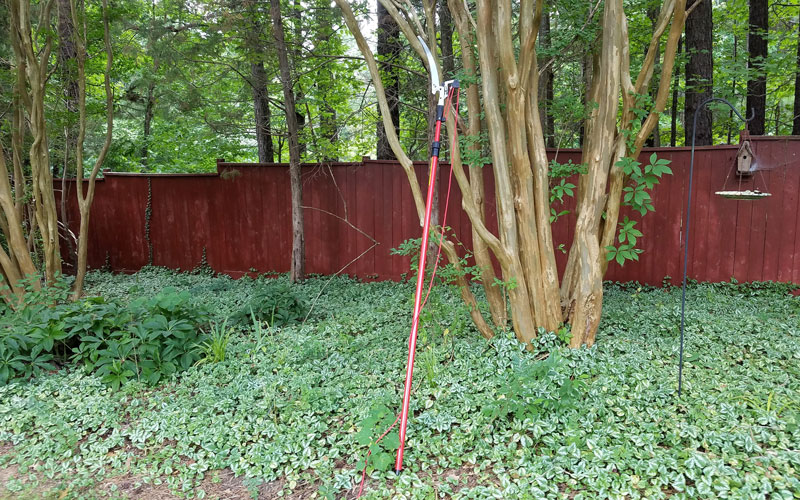
The Corona posing for the camera
ONE BIG LONG BOX
The Corona tool arrived quickly and in good shape. I was happy to see that included with the unit was a little extra: an additional saw blade called a Razor TOOTH Saw®. From the name of this blade, I guessed that it was pretty sharp.
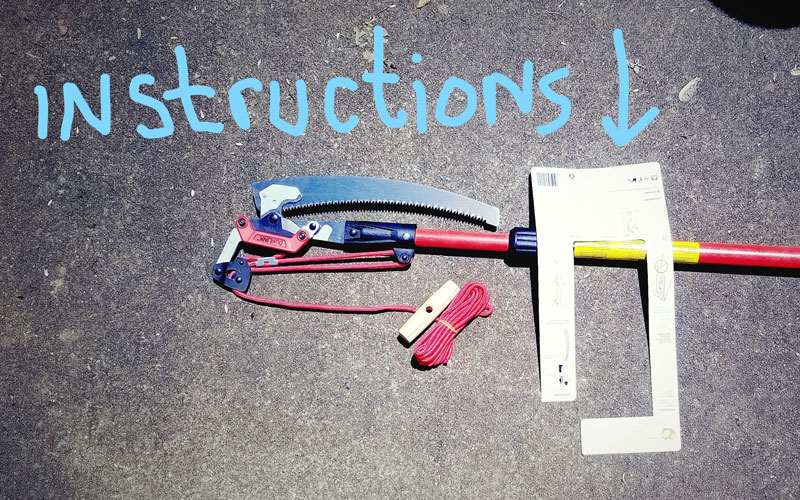
The Corona tool comes with little assembly required
Simple ASSEMBLY
Assembly was so simple that Corona offered no manual. The instructions were simply printed on a card attached to the cutting head.
First, I strung the red nylon pull-rope through the hole in the wooden toggle handle. Then I tied a knot, in the end, to keep it from slipping out.
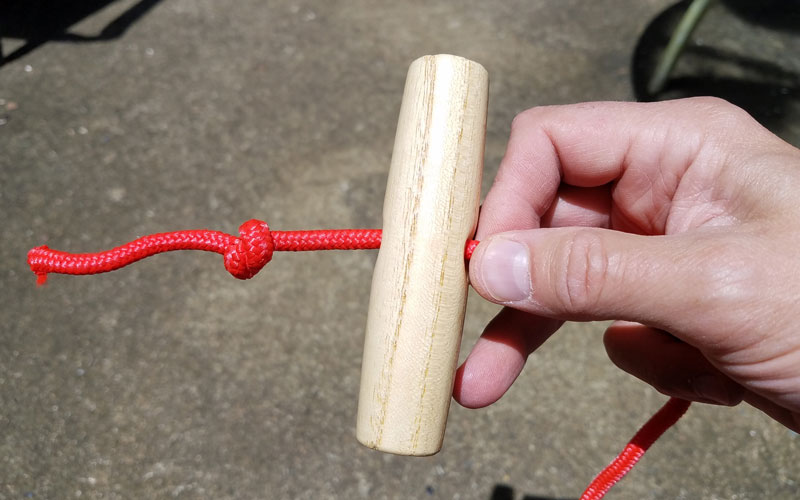
Slide the rope through the wooden toggle handle, and tie a knot in the end to secure it
Next, I connected the saw blade to the pruning head. Align the top hole on the saw blade to the small, protruding tab on the pruner head. Then align the hole in the blade and frame. Insert the bolt, washer, and nut. Tighten with a wrench to secure.
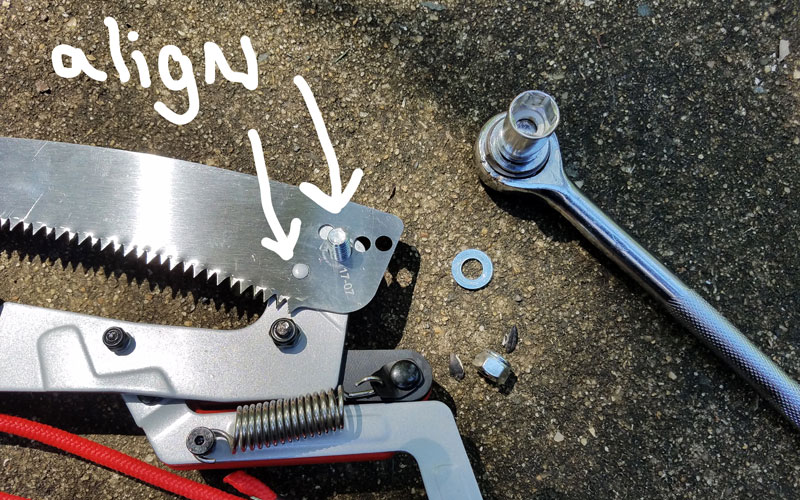
Align the top hole in the blade to the protruding metal tab on the frame. Then insert the bolt through the frame and blade. That’s it. You’re ready to go to work!
Extending the pole – Hold the lower half of the pole handle below the black plastic coupler. With the other hand, twist the top coupler counterclockwise to loosen (lefty loosey, righty tighty). Slide the top portion of the pole out until you reach your desired length. Then turn the top coupler clockwise until tight to secure.
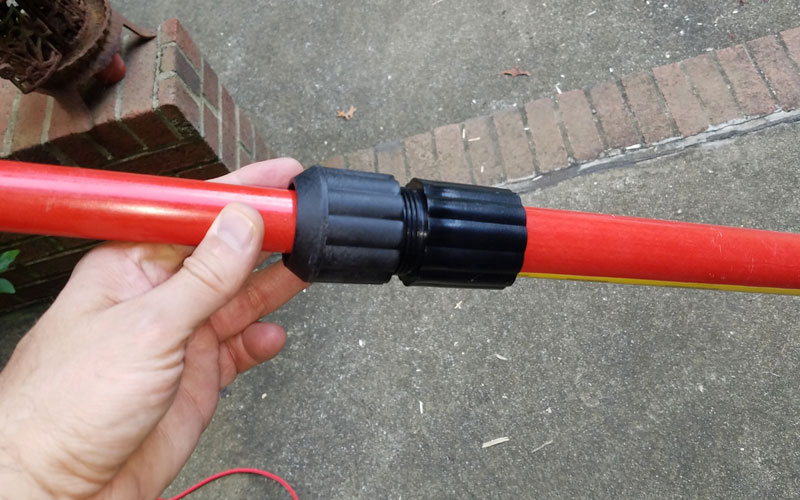
Loosen the top plastic coupler, slide out to the correct length, and then retighten
SAFETY FIRST
It should go without saying, but this product is sharp and care needs to be taken to be safe. I recommend long pants and a long-sleeved shirt to protect your arms and legs from falling branches. Initially, I wore a t-shirt, but just from dragging a few branches, my arms looked like I lost a knife fight. Close-toed shoes are a must, as is eye protection (from falling saw dust) – I like these safety glasses – and leather gloves.
Another important safety precaution is to never leave a combination pole pruner/saw hanging in a tree unattended (it’s tempting to just hang it from the hook when taking a quick break). It can become dislodged and end up hitting a person on the ground or, worse, cutting them with either the pruning blade or saw blade.
SO HOW DOES IT CUT?
I tested the pruner function first. I started pruning with the tool in its most compact form, and then I kept extending it further out until it was fully extended.
Pruning Performance With the Pole Not Extended
The Corona extendable pruner did fairly well-cutting branches at its most compact (i.e., non-extended) length, especially where tree branches were spaced out far enough for me to clearly see the branch and the pruner blade making contact.
The DualLINKTM 3X compound action mechanism touted as offering a 3X Power MultiplierTM, lived up to its name. Was it 3X easier? All I can say is that it was much easier to cut branches than with an older model I own that doesn’t have the compound mechanism.
Pruning Performance With the Pole Extended
As I started to extend the pole, I found it more difficult to judge the girth of the branches I intended to cut. Many times I “cut the air,” believing I had the pruner hooked around a branch but discovering that it wasn’t, usually because the branch exceeded 1 inch in diameter. After a while, my arms got tired from failed attempts. Several times it looked like I had the pruning hook securely placed around the branch, but it somehow popped out.
I finally figured it out. Part of the cutting blade is located inside the hook of the pruner head. With branches larger than 1″ around, the pruner hook would begin to hook onto the branch but stop at the hook/blade interface (instead of being securely hooked over the branch). As soon as I pulled the rope to cut off the branch, the blade would force the branch out of the pruner head and the whole unit would be left hovering in the air. This became exceedingly tiresome.
Bottom line – the Corona extendable pruner is not designed to cut anything beyond 1 inch in diameter so use a saw instead.
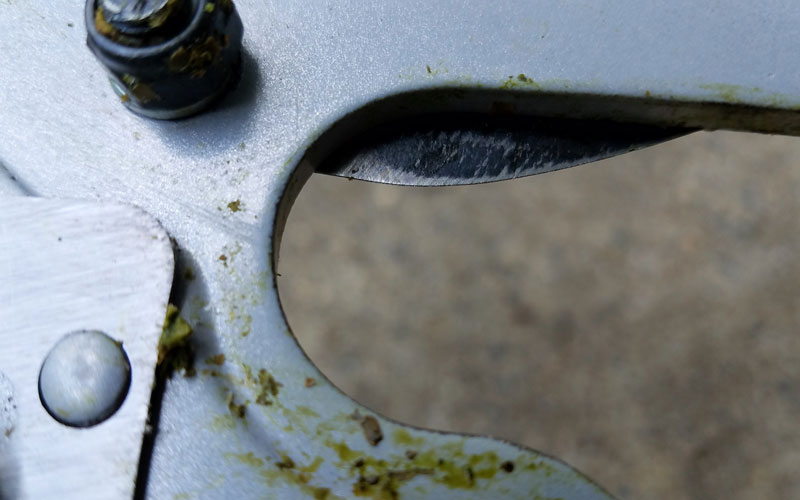
It felt like instead of cutting the branch, the pruning blade squeezed the branch out of the hook
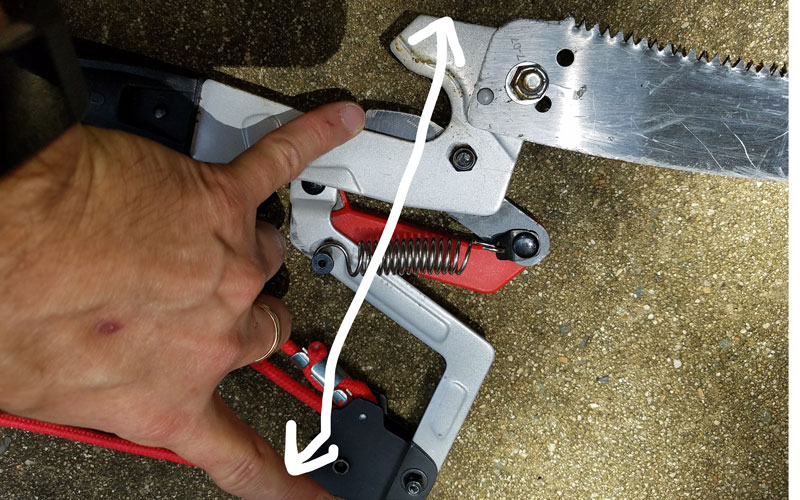
The DualLINKTM system requires much more overhead clearance to cut, room that is not always available in bushy trees
The DualLINKTM compound action pulley system pulled smoothly with no creep in its mechanism. However, when engaged in pruning, the DualLINKTM compound action pulley requires 6″ of clearance above the branch you’re cutting. In practical terms, this means that the pruner may not cut cleanly through a branch because it gets hung up on another branch above it.
Basically, the DualLINKTM system requires more overhead clearance than is often available in bushy trees.
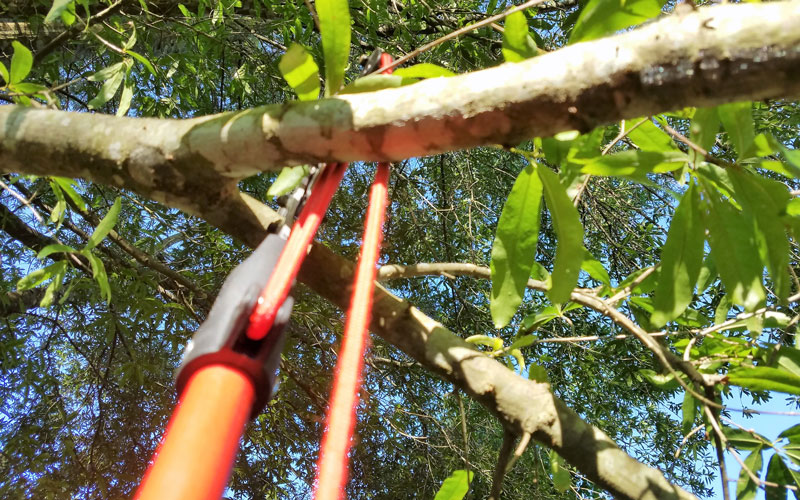
Shown attempting to make a cut but lacking sufficient space to operate the DualLINKTM compound action pulley
The result of requiring so much clear space above the branch is that in order to sever a branch, I found myself having to change angles on the ground until I found the right clearance to complete the cut. This leads to problems. Instead of making a clean 900 cut, I was forced to make angled cuts that left jagged edges (partly because the cut diameter exceeded 1″, even though the branch itself was 1″ or less in diameter).
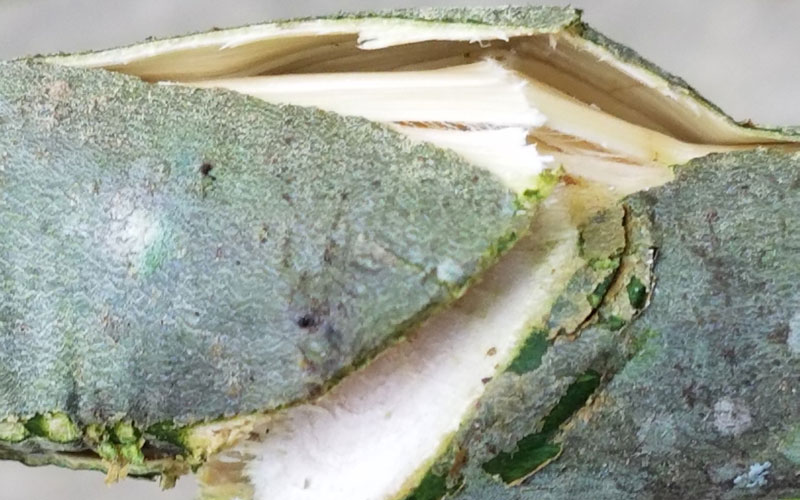
Because of lack of clearance above branches, I opened up the angle, requiring the pruner to cut through more than 1 inch. This lead to jagged cuts.
By the time I finished all the pruning work, each cut was requiring multiple pulls on the rope. I examined the blade for nicks, bends, or alignment issues, but everything looked ok. I couldn’t find the source of the problem.
Things to Try
There are a couple of things I could have done, which are not intuitive when using a pole pruner, particularly when using it at full extension:
Place the pulley below the branch – Flip over the cutting head over so the DualLINKTM pulley mechanism is under the branch to prune. This puts the cutting head closer to the branch. Of course, this will only work if there is enough clearance below the branch to get the cutting head/DualLINKTM pulley mechanism in place (with no interfering branches below it that would cause the same problem as cutting branches from above).
The challenge is that it is counter-intuitive and physically difficult to do when holding an extended pole. Hooking the cutting blade over a branch is much easier than laying the cutting head on top. But it does work if you’re careful.
Cut farther out on the branch – To ensure the DualLINKTM mechanism is free from obstructions from other branches, you may decide to make your pruning cut farther out on the branch. This, however, leaves a long branch stub that is unsightly and the pruning cut may not heal properly. And it may not be possible to cut off the long stubby remains with the pole saw because of tough angles, the DualLINKTM mechanism getting in the way, or the branch is too springy for the saw to actually cut it. This isn’t the preferred option but is sometimes the only choice you have.
As a pruner, the Corona extendable pruner needs some work.
Cutting Performance
I tested the pruning saw function of the Corona extendable pole saw from the most compact form and extended it out until it reached its full 14′ length. As with the pruner, the saw worked best in its shortest form.
As I extended the pole to the 12-14′ length, the pole became less rigid and it was more difficult to maintain a stable point of contact between the blade and the tree branch. The ensuing bounce made it nearly impossible to get a cut deep enough to create a rut in the branch. Instead, the blade ended up hacking the branch. It should be mentioned that I was using the standard blade that came attached with the saw, not the Razor TOOTH Saw® (more on that below).
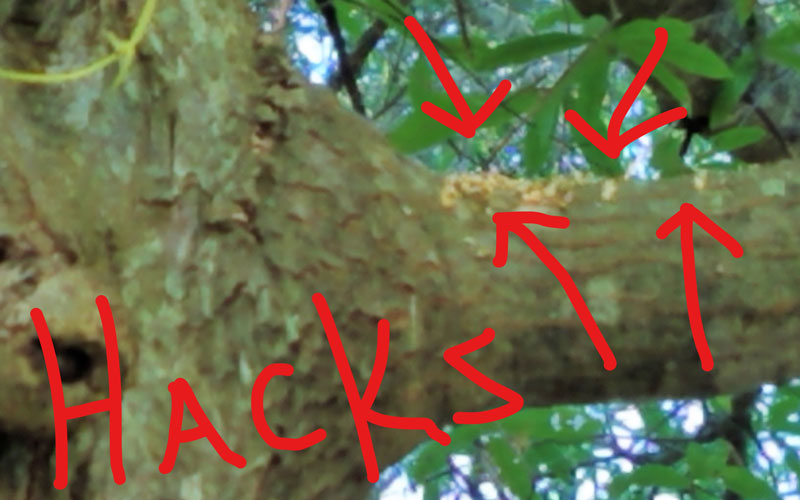
The further the pole extended, the less solid the contact between the blade and the tree branch.
The extendable portion of the pole closest to the blade and pruner head slides inside the lower pole section. Because of this, it’s significantly thinner than the lower portion, making it bounce and bend when pressure is applied.
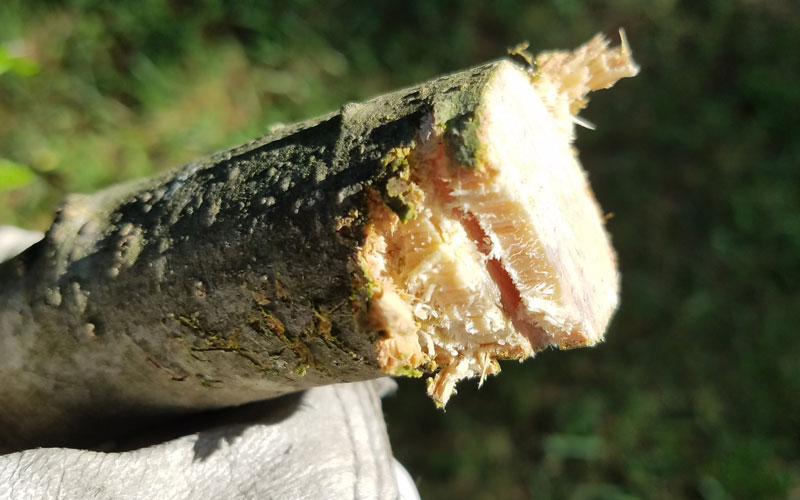
Even on smaller branches, the blade bounced around wasting energy and forcing me to make new cuts
Fully extended, the pole did not retain enough stability to make clean cuts. Lacking a hook at the tip of the blade, some long pulls of the saw made the blade slip off the branch I was cutting. A couple of times the blade got pinched in the cut.
Strong pulling also loosened the twist lock handle and the pole extended unexpectedly. A better locking mechanism would’ve been helpful.
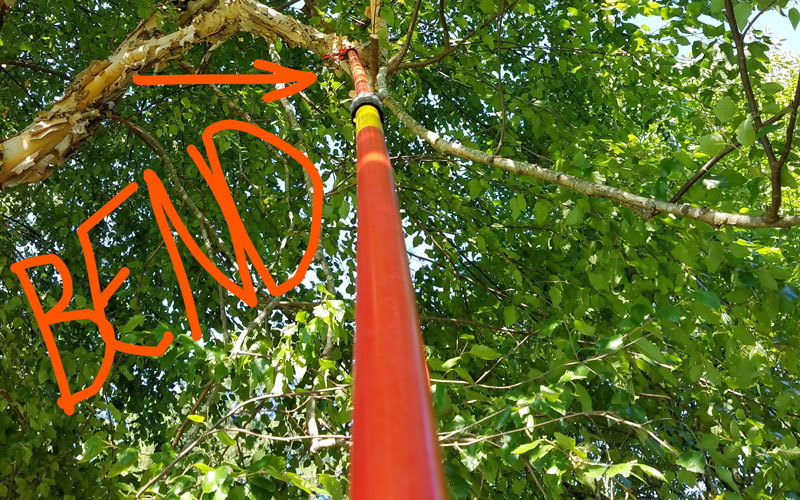
Shown pole bending while using the saw blade.
Using the Razor TOOTH Saw® Blade
Just when I was ready to stop, I decided to try the included Razor TOOTH Saw® blade. It attached just like the original blade.
When I held the Razor Tooth Saw® next to the original blade, I didn’t see much of a difference.
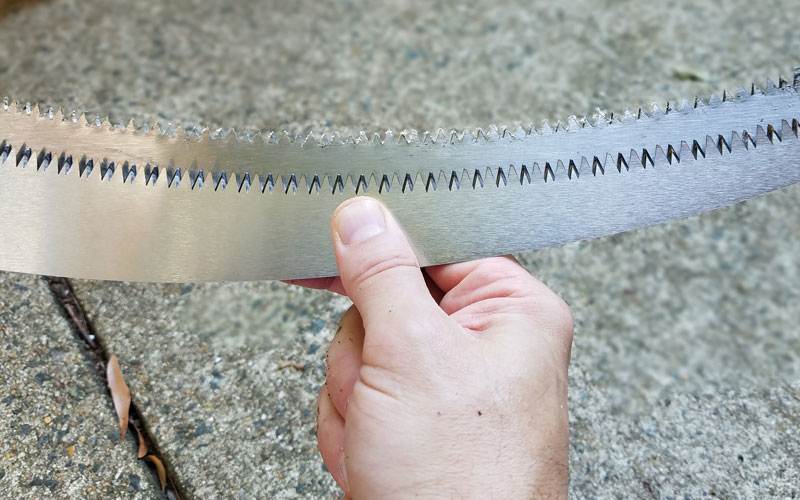
The original blade compared to the Razor TOOTH Saw® blade didn’t show a big difference
But once I put the blade against the first branch, I learned the two blades are very different. The Razor TOOTH Saw® cut cleanly and with much less effort. The blade had enough sharpness to compensate for the spring in the pole and the lack of a hook on the blade.
In my opinion, this blade is the best part of the Corona DualLINKTM Extendable Tree Saw and Pruner. Using this blade, I easily cut through 5″ and 6″ oak branches, the blade stayed sharp and it made nice clean cuts.
Note: We talk more about the Corona Razor TOOTH Saw in our Best Pruning Saws Guide.
WARRANTY
The Corona DualLINK™ Extendable Tree Saw & Pruner comes with a lifetime limited warranty. This only covers defects in materials and workmanship.
PROS AND CONS OF THE CORONA DUALLINK™ EXTENDABLE TREE SAW & PRUNER
There were definitely some things to like about the Corona DualLINKTM Extendable Tree Saw & Pruner:
- Lightweight – The unit is extremely light, which can be both a blessing and a curse. On the plus side, the light weight means you can use it longer without fatigue.
- Razor TOOTH Saw® blade – This blade can cut! It is much better than the originally supplied blade.
- DualLINKTM compound action pulley – The pulley reduced the amount of strength needed to get a solid pull on the pruner. The 3X cutting power really made a difference in making it through harder wood, such as oak.
- Twist lock – The Corona extendable system uses a simple, effective twist lock to loosen and tighten the pole to achieve the optimum length.
Here are some things I would like to see improved:
- Pruner max cutting diameter – For a variety of reasons, the pruner did not work well for me. For starters, I think the 1″ maximum cutting diameter is too limiting, especially given the high clearance needed above the tool. Increasing the size of the blade and maximum cutting diameter would allow you to change your cutting angle yet still get a clean cut.
- Saw blade – The Razor TOOTH Saw® blade should be the standard blade. Ditch the original saw blade that came attached to the unit.
- Extendable top pole – By keeping the weight down, the extendable portion of the pole bends under use. This top section needs to be made of a more rigid composite to reduce its bounce.
- Loose coupling – The pole would extend on its own when pulling the saw hard through a saw pruning cut.
RECOMMENDATION
I have had good experiences with some of the Corona products I’ve tested in the past and even given our highest rating to one of them. The lightweight Corona DualLINKTM Extendable Tree Saw & Pruner has some benefits, such as the DuraLINKTM 3X compound action which makes pruning 1″ branches much easier and the terrific Razor TOOTH Saw® which cut through hardwood with ease.
However, the pruner head needs 6 inches of clearance to make a clean cut (something you often don’t have when pruning overgrown trees), the fully extended pole is too springy so it makes the saw blade bounce around, and the locking mechanism slips when under pressure.
I would like to have seen a larger pruning capacity (up to 1 ¼ inch) for those tougher cuts. The unit should have come with the Razor TOOTH Saw® as the standard blade (get rid of the original blade).
Because I had difficulties in several important areas, I cannot give it high marks in performance. The quality was average, something I’d expect from a lower end manufacturer and not something that bears the Corona name. Overall, I found it an average product from a company that I expect to do better.
WHERE TO BUY
You can purchase the Corona DualLINKTM Extendable Tree Saw & Pruner on Amazon.
You can also buy it directly from Corona’s website where it currently retails for $78.99.

Corona DualLINKTM Extendable Tree Saw & Pruner

[ad_2]
Source link : https://gardeningproductsreview.com/corona-duallink-extendable-tree-saw-pruner-review/