


[ad_1]
Steps
Part 1
Part 1 of 3:
Setting Up the Weave
-
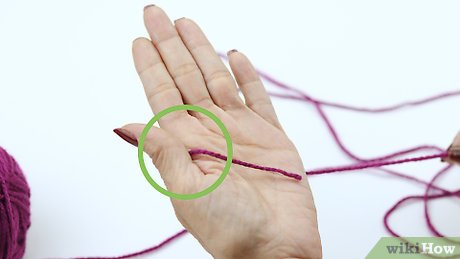
1Hold the yarn between the thumb and index finger of your non-dominant hand, leaving a short length of extra yarn (the “tail) at the end. Keep your thumb pressed against the side of your index finger in order to keep the yarn in place. Turn your hand so that your palm faces you.
-
 2Start the weave. With your palm facing you, take the “working end” of the yarn and weave it behind your index finger, over your middle finger, behind your ring finger, and over your pinky finger. During the weaving process, be sure to keep the tail tightly gripped between the side of your thumb and index finger.[1]
-
3Loop around and continue weaving. Once you reach the end of your hand, loop the yarn around your pinky and continue the weave, this time in the alternate pattern. After it wraps around your pinky, the yarn will go over your ring finger, behind your middle finger, and over your index finger.
-
4Repeat this sequence. Wrap the yarn around your index finger and then repeat the original wrapping pattern: behind your index finger, over your middle finger, behind your ring finger, over and around your pinky finger, over your ring finger, behind your middle finger, over and around your index finger. Once finished, you should have two loops around each finger.[2]
Part 2
Part 2 of 3:
Knitting
-
1Pull up the bottom loops. Starting with your index finger, take the bottom loop of yarn and pull it up, over (the top loop), and off of your finger. Once finished, the bottom loop should now be on the back of your index finger.[3]
-
2Repeat with the next three fingers. Pull the bottom loop up, over, and off of your middle, ring, and pinky fingers. Once finished, you should have one loop on each finger.
-
3Reposition the yarn. Using your dominant (free) hand, press the yarn down so that the remaining loops are closer to the bottom of your fingers and do not risk falling off.
-
4Continue the weave. Grab the tail (which should be between your index and middle fingers) and wrap it over your middle finger, behind your ring finger, and over and around your pinky. Continue the other direction by wrapping it over your ring finger, behind your middle finger, and over and around your index finger. Once finished, you should once again have two loops on each finger.[4]
-
5Repeat pulling up the bottom loops. As with before, start with the index finger and pull the bottom loop up, over (the top loop), and off your finger. Repeat this for the remaining three fingers until you end up with only one loop on each finger.
-
6Repeat repositioning of the yarn. Once again use your dominant (free) hand to slightly push the yarn down so that the remaining loops are closer to the bottom of your fingers, allowing additional room to continue the weave.
-
7Repeat these three actions (weaving, pulling up loops, repositioning) as long as desired. A nice, rope-like structure of yarn should form at the back of your hand, which will allow you to roughly gauge the length you’ve made. Don’t be afraid to lightly tug on it to tighten it up as you go.
Part 3
Part 3 of 3:
Finishing Off
-
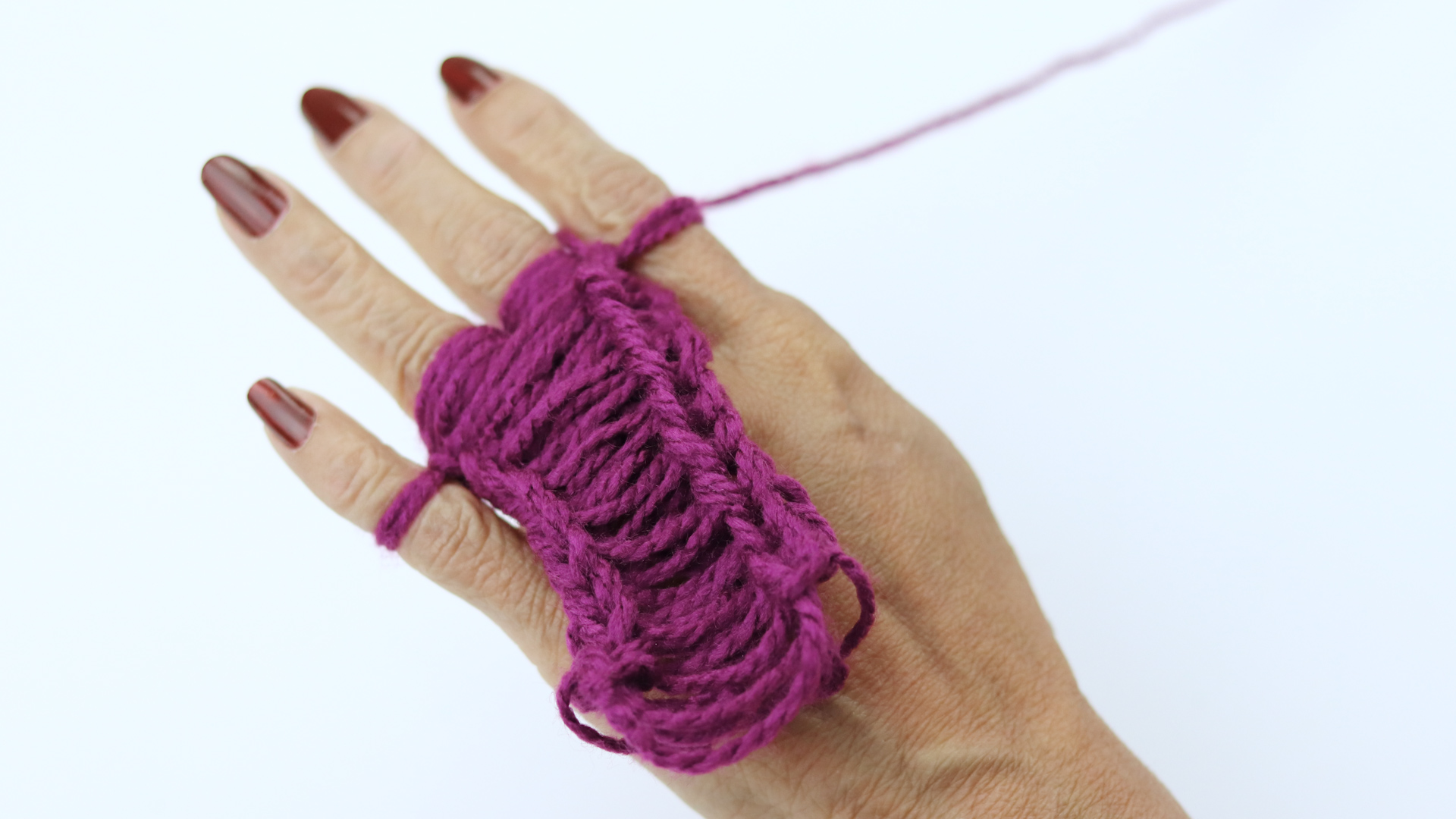
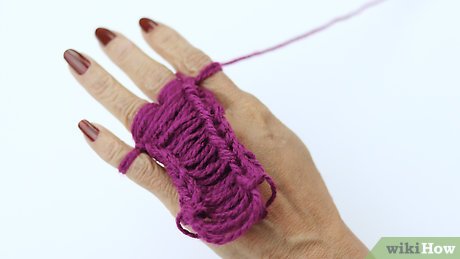 1Stop weaving. Once your rope is as long as you want it, stop with one loop on each finger, just after you’ve pulled over the bottom loops. Do not continue to weave.
 -
2Finish your index finger. Take the remaining loop from your index finger and flip it up and over, onto your middle finger. Now, pull the bottom loop up from your middle finger and over to the back of your hand.[5]
-
3Finish your middle finger. Take the remaining loop from your middle finger and flip it up and over, onto your ring finger. Again, pull the bottom loop up from your ring finger and over to the back of your hand.
-
4Finish your pinky. Take the remaining loop from your ring finger and flip it up and over, onto your pinky. Again, pull the bottom loop up from your pinky and over to the back of your hand. Once finished, you should have on loop on your pinky.
-
5Slip the loop off your pinky. Be careful to not let the loop close once it is off your finger.
-
6Cut the working end of the yarn a few inches away from the loop. Be sure to leave a few inches of extra yarn at the end.
-
7Pull this working end (now a new tail) through the loop. Tug it a few times to tighten the loop upon the new tail.[6]
-
8Tighten the other end. Return to the original tail and also give it a tug to tighten off the other end. If desired, you can even tie a knot to finish off this end.
-
9Finished. If you want your yarn to make a circle (for a bracelet, headband, etc.), tie the two ends in a tight, square knot. If not, you’re all done.
Video
Tips
-
It is much better to do this all in one sitting, or you might lose the rhythm and forget where you were. If you do take a break, slide a pencil through the loops where your fingers are to save your place.[7]
⧼thumbs_response⧽ -
Thick and soft yarn works best. Thin yarn creates big holes in the finished product because the “needles” you’re working with – your fingers – are comparatively large.⧼thumbs_response⧽
-
Try to wrap the yarn loosely around your fingers so it is easy to pull over.⧼thumbs_response⧽
Submit a Tip
All tip submissions are carefully reviewed before being published
Thanks for submitting a tip for review!

Warnings
-
If you pull on the yarn too tightly when it is on your fingers, it can cut off circulation. Remember to keep it loose.⧼thumbs_response⧽
-
If you see loose loops in your rope, don’t cut them. If the loop is close to your knuckles, just pull out the stitches back to the problem and redo that part.⧼thumbs_response⧽
-
If you suffer from repetitive stress injury, remember to take frequent breaks.⧼thumbs_response⧽
Things You’ll Need
-
Yarn
-
Scissors
-
Fingers
You Might Also Like







[ad_2]
Source link : https://www.wikihow.com/Finger-Knit