


[ad_1]
Steps
Dancing Freestyle
-
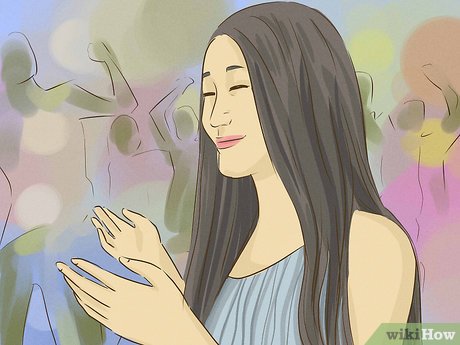
1Bob your head to the rhythm. Start by trying to find the beat of the music. If it helps, try counting along, clicking or clapping your hands to the beat.[1]
Once you’ve figured out the rhythm, start moving to it by bobbing your head.[2]
- Once you get your head moving, it will make it easier for you to get the rest of your body going.
- To find the beat, try listening to the drums or the bass. These instruments usually carry the rhythm of the song.
Tip: To get used to finding the rhythm of a song, practice by listening to songs with a clear and pronounced beat. For example, try clapping and moving along to the beat of a song like “Juke Joint” by Johnnie Taylor.[3]
-
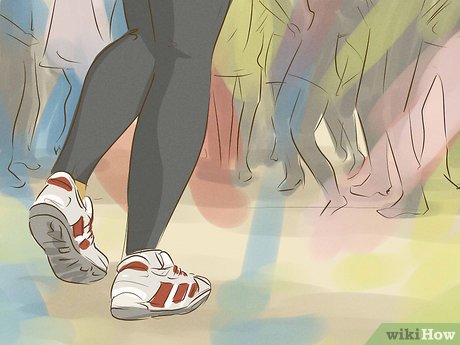 2Shift your weight from one foot to another and spin to the beat. When you have a good sense of the beat, you can start incorporating some simple footwork. Start by shifting all of your weight to one foot. You can lift the other foot slightly off the ground to make sure all your weight is off of it. Shift back and forth in time to the music.
- At every other count, shift your weight completely to the other foot. You can also shift your weight at every count but by starting out slowly, you will get comfortable before you begin dancing fast.
- Keep your legs loose and your knees slightly bent. There should be just a bit of “bounce” to your weight shift, and a subtle bounce (in place) on the counts when you aren’t shifting your weight.
-
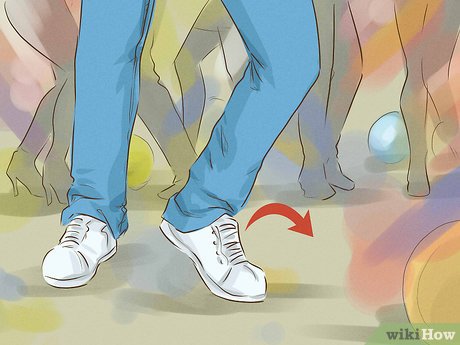 3Move your feet to the beat. Once you’re comfortable shifting your weight to the rhythm, begin moving your feet. Right before you shift your weight to a foot, move it slightly, even just 1–2 inches (2.5–5.1 cm) from where it was before. When you move your foot, keep it fairly close to the ground.
- Stay on the balls of your feet so you can move and bounce easily.
- If you’re dancing with someone else, be sure to move around in a way that accommodates your partner.
-
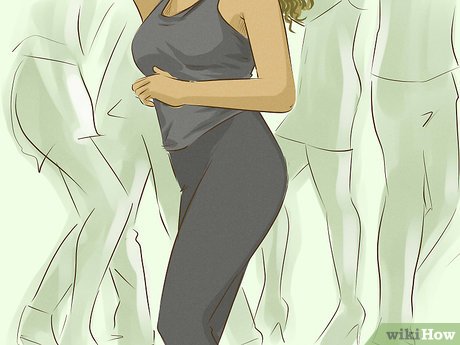 4Add some hip action. When you put your weight on a foot, move your hips (and your body) slightly in the direction of that foot. If you shift your weight onto your right foot, for example, move your hips to the right. You can twist your body slightly to add a little more movement.
- For example, when you move to the right, put your right shoulder forward a little and your left shoulder back. Do the opposite when you move to the left.
-
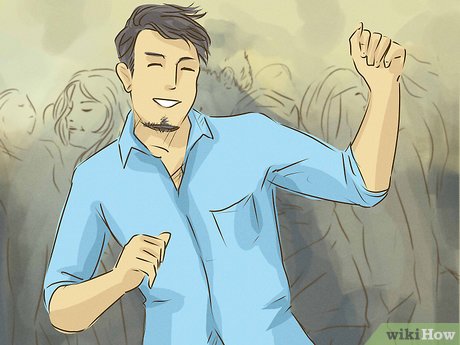 5Incorporate some arm movements. If you’re uncomfortable, the tendency is to keep your arms close or to let them hang limp. Instead, move your arms around. Keep your hands open or in very loose fists. You can put your arms in the air or bend them at the elbows and hold them at your sides, like when you’re running. Whatever you do, don’t get stuck on just one move; keep switching it up! You can also try one of these moves:
- Roll the dice. Make a loose fist and shake your arm and hand as though you are shaking a pair of dice for a roll. After a few shakes, “roll” the dice. Don’t overuse this move to the point that it becomes comical.
- Mow the lawn. Bend forward and grasp the starter of an imaginary lawn mower with one hand, then pull your hand back as though you’re pulling on the starter. Once you get it going, you can take a few steps while you mow the lawn.
- Swing an air lasso. Grab an imaginary lasso and swing it above your head as though you’re about to rope a cow. Shift your weight to the foot opposite your “lasso hand” and thrust your hips in that direction.
- Pump your fist. Make a fist and then make a pumping motion overhead in a celebratory fashion.
-
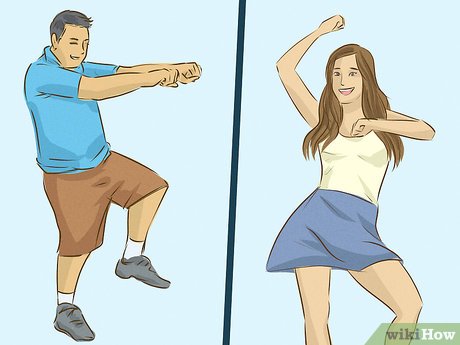 6Find your own style. Follow your natural impulses when you’re dancing freestyle. It’s easy to feel like you’re only good at one move, but the more you feel the rhythm, the more natural your movements will become. Listening to subtleties in music will also help to train your body to move. Most importantly, be creative! Creating your own dance moves is easy with confidence and an understanding of your body.[4]
- Experiment with different moves, positions, and speeds while you dance.
- Don’t be afraid to make up your own moves. Free style is all about improvisation and individual expression.
Slow Dancing with a Partner
-
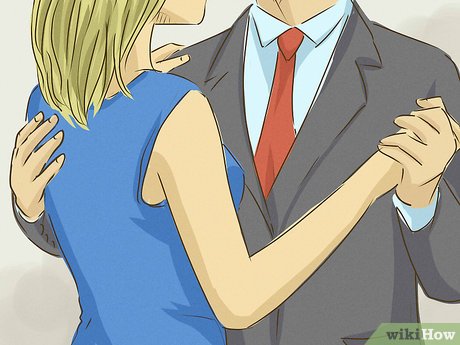 1Get into position with your partner. Stand face-to-face with your partner and get into a basic partner position. If you are leading, put your right hand on your partner’s shoulder blade and interlock your left hand with their right hand, with your hands positioned in the shape of a pair of Cs. Your partner will put their left hand on your right shoulder.[5]
- You can keep your clasped hands held as high as eye level or as low as waist level, depending on your preference. Just keep them relaxed, with a comfortable bend at the elbow, and don’t raise your partner’s shoulder.
- Leave about 3–6 inches (7.6–15.2 cm) of space between yourself and your partner.
- Make sure you and your partner agree on who is leading before you begin!
Tip: Slow dances are typically performed by a man and a woman, with the man leading. However, there’s no need to stick to this traditional arrangement. Pair up with a partner of any gender you like, and decide with your partner who should lead based on confidence, height, or whatever other factors you choose.
-
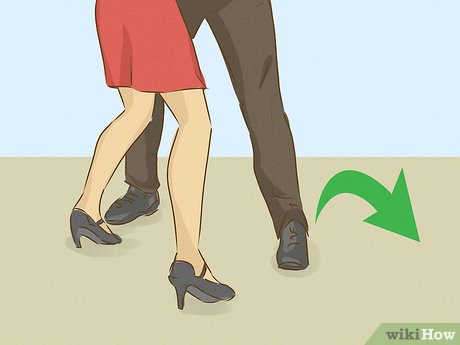 2Step to the left with your left foot. Once you’re ready to start dancing, move your left foot out to the side in a smooth, gliding motion. Your partner will mirror you with their right foot. This is the first part of the basic “step-touch” slow dance move.[6]
- If your partner is leading, let them initiate the first step, but try to move with them as smoothly as possible.
- Try to time your steps with the beat of the music. You may find it helpful to count along with the music in your head.
-
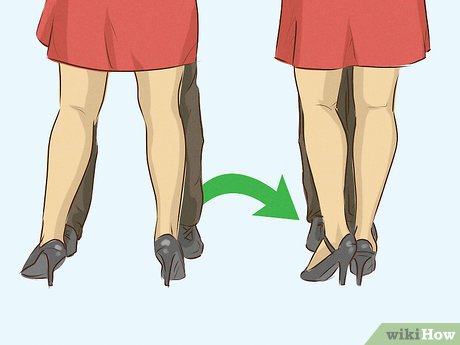 3Bring your right foot over to meet your left. After taking the first step with your left foot, slide your right foot over so that it touches your left. Your partner should mirror this movement.[7]
- Try not to bounce or dip as you bring your feet together. Aim for a smooth, gliding movement.
-
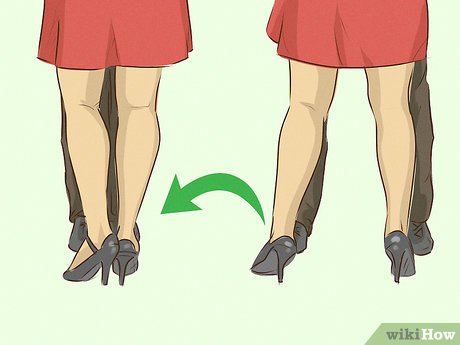 4Repeat your foot movements in the opposite direction. Once you’ve brought your feet together, step to the right with your right foot. Then, bring your left foot over to meet your right. Continue this pattern throughout the rest of the dance.[8]
- Alternatively, you can do 2 steps to the left and then 2 steps to the right.[9]
- Alternatively, you can do 2 steps to the left and then 2 steps to the right.[9]
-
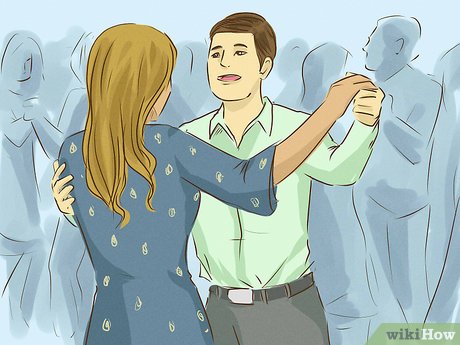 5Use your hands to steer your partner if you want to move around. If you’d like to move around the dance floor, use your hands to gently push or pull your partner in the direction you’d like to go. After touching your feet together, push with one hand and pull with the other at the same time that you step out on the next beat.[10]
- For example, if you’re stepping left but want to pivot to the right, start by bringing your right foot to meet your left. Then, push your partner’s right hand with your left hand while gently pulling on their shoulder with your right hand, and step to the left at the same time.
Dancing at a Wedding
-
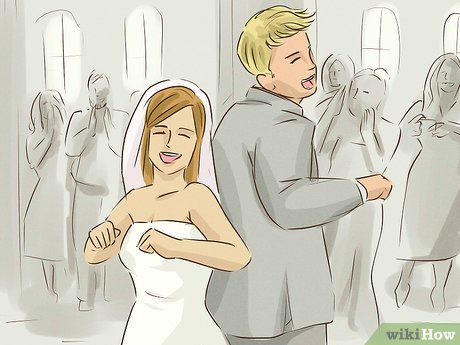 1Learn the Chicken Dance for lighthearted numbers. The Chicken Dance is a staple of many wedding receptions. It’s easy to do because there are just 3 basic moves, and you change them in time with the music. This is also a very low-pressure dance—no one cares if you mess up. To do the chicken dance:[11]
- Raise your arms to shoulder level and line your thumbs up with your index fingers to create a shape that resembles a chicken’s beak. Move your thumbs up and down to simulate a chicken clucking.
- Then, ball up your hands and tuck your fists under your arms as though you have wings. Flap your wings up and down in time to the music.
- With your wings still in place, continue flapping but now stick out your backside, bend your knees and wiggle your bottom down toward the floor.
- Repeat these moves over and over until the song ends.
-
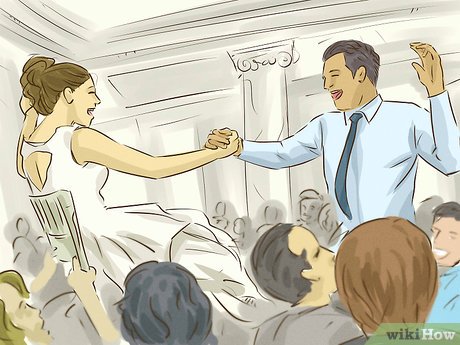 2Master the hora for Jewish weddings. The hora is danced at many traditional Jewish wedding receptions to the song “Hava Nagila” or other traditional Jewish songs. The hora simply involves dancing in what’s known as a “grapevine” pattern:[12]
- Step the left foot across to the right. Let the right foot follow. Step the left foot behind the right. Follow again with the right.
- This dance is performed in a circle with dancers either holding hands or throwing their arms over one another’s shoulders.
- The tempo of this dance is typically fast. Sometimes the music starts slowly, and the band speeds up the tempo as the song goes along.
Did you know? At Orthodox Jewish weddings, men and women dance the hora separately. At more liberal weddings, guests mingle and do the dance together.
-
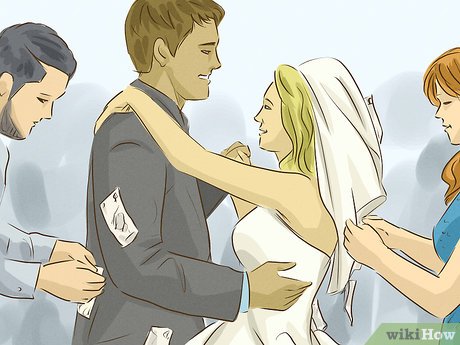 3Use basic slow dance moves for the Dollar Dance. At some weddings, the guests line up and pay a dollar (or more) to dance with the wedding couple. You can use basic slow dance moves for this dance, but it’s really not about the moves; it’s about having a few moments with the merrier to express your happiness for the couple and compliment the wedding ceremony and reception.[13]
- Holding on and simply swaying in place is perfectly acceptable if it makes it easier to have a personal conversation.
Getting All the Right Moves
-
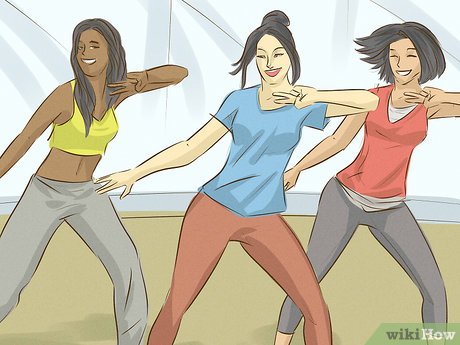 1Take a dance class to learn some basic moves. There are dance classes for every style of dancing from hip-hop to ballet, break dancing to salsa. Search online for the classes in your area. Whatever style of dance you’re interested in, you could probably benefit from a ballroom dancing class as the steps of many other dance styles have their roots in some ballroom basics.
- When you are being taught a routine, look at what the teacher is doing. Try to copy it exactly. If it doesn’t work, watch the teacher again and look for the little things they do that make it easier.
- Go ahead and ask your instructor for tips. Experienced instructors have worked with hundreds of students and have ideas that can help you overcome whatever it is you’re finding to be difficult.
- Even a few hours of class time can help you learn the basics and build your confidence.
-
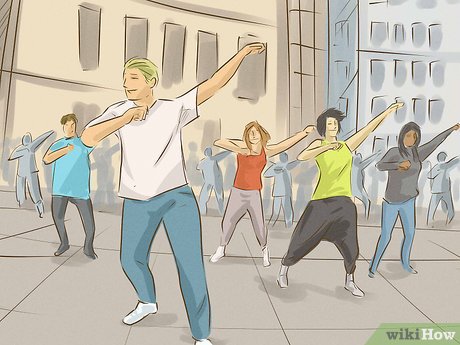 2Join a flash mob to boost your confidence. A flash mob is a spontaneous public performance—usually a dance—that appears seemingly out of nowhere and then disappears just as quickly. While these dance performances may seem spontaneous, the truth is that they’re usually fairly well rehearsed in advance. You can find flash mobs online, join them for a several-week rehearsal period as the group learns a dance, and then perform with the mob in public.[14]
- Some flash mobs put videos online with instructions for learning and rehearsing the planned dance.
- Flash mobs welcome people of all skill levels; their focus is on having fun and creating a joyful scene, so the more people who participate, the better.
- You’ll also learn some great dance moves and connect with other people who enjoy dancing.
-
 3Watch dancing on TV to find inspiration. Dancing is a wildly popular activity, and you can get plenty of exposure to it just by watching TV.[15]
Try tuning in to reality television dance competition shows. Focusing on the steps might be a bit challenging. Instead, pay attention to how loose the dancers are, how much confidence they display, and how much fun it looks like they’re having on the dance floor.- Popular current dance shows include Dancing with the Stars and So You Think You Can Dance.
-
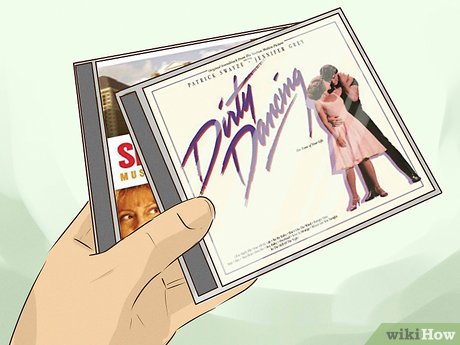 4Rent a classic dance movie to get new ideas. There are so many dance movies to choose from. See as many as you can or pick and choose those that speak to your particular interests. For example:
- Check out Dirty Dancing or Shall We Dance to watch 2 dance novices develop confidence and grace and learn to perform with pizzazz.
- Watch Footloose or Flashdance to see the power of dance as a form of defiance against uptight authority figures and personal circumstances.
- Rent anything starring Fred Astaire and Ginger Rogers to be inspired by the grace and elegance of these famous dance partners.
- Watch Stormy Weather to see the Nicholas Brothers push the limits of tap dancing.
-
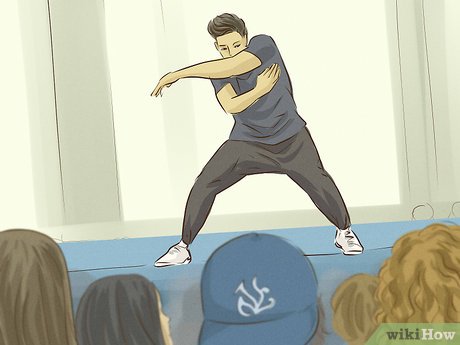 5Participate in a dance competition to hone your skills. Ballroom dancing competitions, officially known as DanceSport events, are held all over the world. Check online for a competition near you. Joining a dance competition can help you set specific goals for yourself and encourage you to build your skills.
- Check out websites such as the International Grand Ball, United States Dance Championships, and the Access Dance Network to name just a few.
Tip: If you’re not confident enough to join a competition yet, attending competitions as a spectator can help inspire you and give you an idea of what to expect.
Dressing to Dance
-
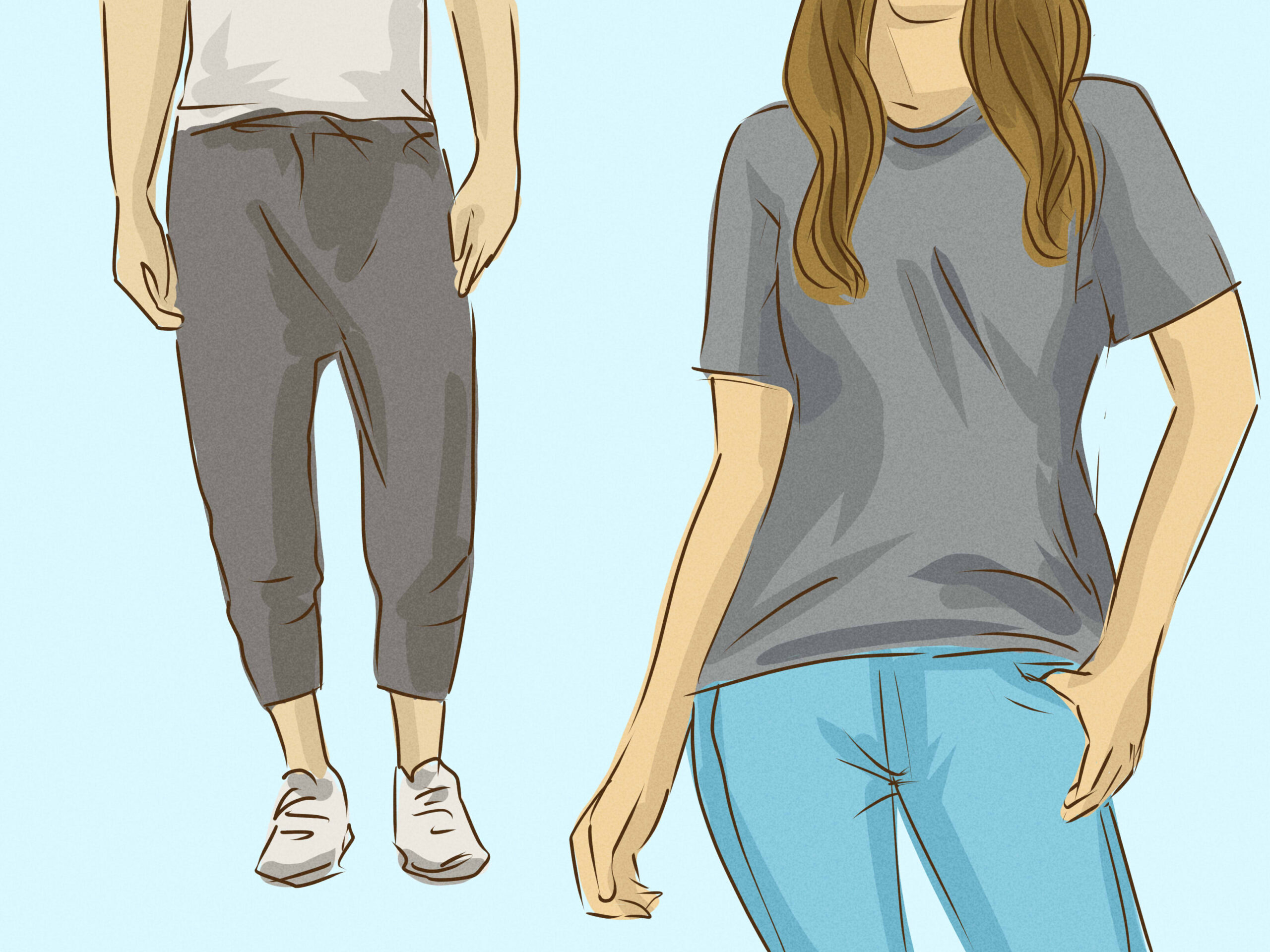
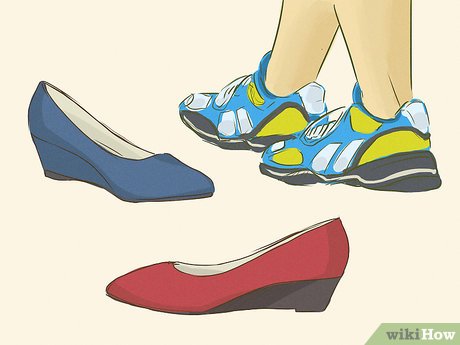 1Put on comfortable dance shoes. Choose a well-fitting shoe with a flexible, thin sole for the dance floor. Stay away from platform shoes, since that thick sole and heel make it difficult to feel the floor. Be sure, too, that your feet feel secure in your shoes. Backless sandals are best left at home. Do not wear sneakers or other shoes with rubbery or sticky soles for ballroom style dancing, since these can make it hard to move your feet smoothly across the floor.[16]
- Different styles of dance call for different types of shoes, so do some research about what’s needed for your preferred style. For example, sneakers are great for hip hop or freestyle dancing, while heels are ideal for Latin dance styles.
-
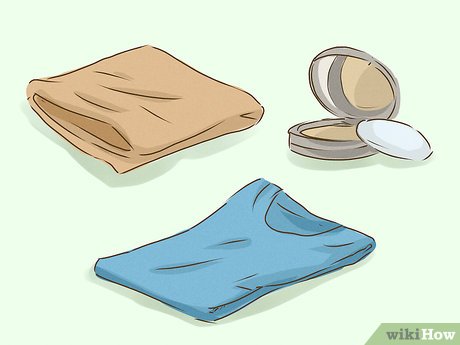 2Be prepared for the heat. If you tend to perspire, choose garments made of natural fibers. Tank tops and halter tops can look great, but sweaty or clammy skin could be a turn-off if a partner asks you to dance. Drop a pack of moist towelettes and a travel-size powder in your pocket so you can freshen up when needed.
- If you’ll be dancing with a partner, avoid wearing slippery materials, like silk. Your partner may have a hard time holding onto you if their hands get sweaty.[17]
Tip: Consider bringing a spare top or a change of clothes in case you really work up a sweat.
- If you’ll be dancing with a partner, avoid wearing slippery materials, like silk. Your partner may have a hard time holding onto you if their hands get sweaty.[17]
-
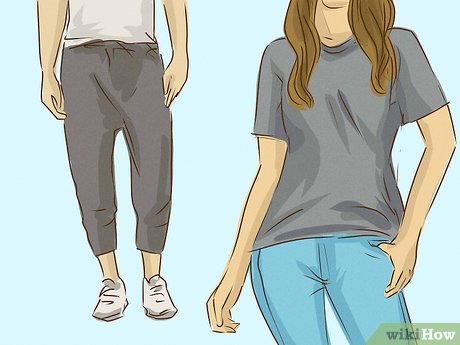 3Wear clothes that allow you to move. Tight satin might look and feel great when you’re not moving much, but it could inhibit your moves on the dance floor. Even worse, one wrong move could leave you with an embarrassing rip. Choose clothes that are either loose enough to let you move or stretchy enough to move with your body. Select a top with sleeves that don’t restrict your arm movement—you should be able to lift your arms above your head.[18]
- Try on your outfit at home to be sure you can dance with ease.
- To avoid wardrobe malfunctions, make sure your clothing fits securely and won’t slip out of place if you really get moving!
Video
Tips
-
Watch other dancers. If you’re not sure how to dance to a song, take your cues from other dancers. You don’t want to copy them exactly (unless it’s a standardized dance), but you can get some ideas.⧼thumbs_response⧽
-
Smile and try to look like you’re having fun, even if you’re nervous and not sure what you’re doing. Acting confident can help you feel more confident.⧼thumbs_response⧽
-
If you feel shy or you fail to do some steps, don’t give up; keep on practicing.⧼thumbs_response⧽

Warnings
-
Don’t over-exert yourself or try any dance moves that you aren’t comfortable with and haven’t practiced extensively already. Good dancers make hard moves look easy—don’t be fooled. You really can pull a muscle or trip and fall (especially if you’re wearing heels). You can look good dancing without doing any of the fancy stuff. yup.⧼thumbs_response⧽
You Might Also Like

[ad_2]
Source link : https://www.wikihow.com/Dance